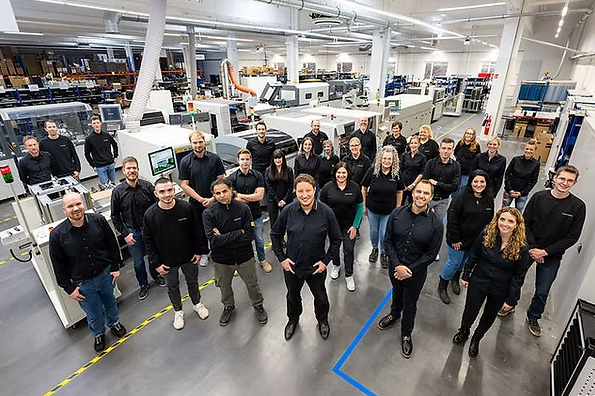
A photo of Lumistrips LED Professional

Lumistrips LED Professional

About the Author: Lumistrips LED Professional

The Lumistrips LED Professional team is the engineering and application knowledge group behind Lumistrips — a German manufacturer of custom LED modules and flexible LED strips with more than 20 years of experience in LED design, development, and production.

Based in Hechingen, Germany, Lumistrips was founded at the beginning of the LED era and has developed alongside the technology since its commercial inception. That longevity is reflected in the depth of the team's application knowledge: from early-generation phosphor-converted white LEDs to today's photobiology-optimised horticulture components, precision optics systems, and intelligent control electronics.

Areas of Expertise

The team writes and publishes on subjects where Lumistrips has direct, hands-on engineering experience accumulated across thousands of projects. Core areas include:

  • Horticulture LED lighting — spectral design for plant growth, PPFD engineering, PCB substrate selection for greenhouse and vertical farm applications, and LED component selection from the world's leading manufacturers including Nichia, Cree, Seoul Semiconductor, Osram, and LumiLeds
  • Custom LED module design and manufacturing — application-specific module development across FR4, aluminium, and flexible PCB substrates, including Reel-to-Reel (R2R) automated flex manufacturing for high-volume production
  • LED optics and light distribution — precision secondary optics from LEDiL, Carclo Optics, Gaggione, and ARI International Corporation, and their application to uniform PPFD delivery, architectural lighting, and specialty illumination
  • High-CRI and full-spectrum LED technology — human-centric lighting, colour rendering accuracy, and natural spectrum LED systems for retail, medical, art, and horticultural applications
  • LED thermal management and lifetime engineering — junction temperature control, lumen maintenance standards (IES LM-80), and system-level design for long operational lifetimes in demanding environments
  • LED drivers and control systems — constant current and constant voltage driver selection, dimming protocols, and spectral sensing for intelligent lighting control

Manufacturing Credentials

Lumistrips designs and manufactures LED modules and strips in Germany, operating both SMT (Surface Mount Technology) production lines and a dedicated Reel-to-Reel flexible LED strip manufacturing facility. The team holds official distributor and partner status with leading LED and optics manufacturers, including authorised distributor relationships with LEDiL and Carclo Optics, and direct supply partnerships with Nichia, Cree, Seoul Semiconductor, Osram, and LumiLeds.

Lumistrips products are supplied to lighting manufacturers, greenhouse operators, vertical farm developers, architectural lighting designers, and research institutions across Europe and internationally. The standard product warranty is five years, with selected LED strip products carrying a seven-year warranty — a direct expression of the confidence the engineering team places in the quality of materials and manufacturing processes used.

Knowledge Base

Content published under the Lumistrips LED Professional authorship draws on a proprietary knowledge base built over two decades of project work, including a systematic review of more than 100 peer-reviewed studies on LED illumination effects in plant growth and horticulture, and a database of more than 1,400 analysed LED lighting systems across application sectors. Articles are written to engineering peer standards — evidence-based, technically precise, and free of generic marketing language.

Lumistrips does not accept sponsored content or paid placement. All product references in articles reflect genuine application experience and manufacturer relationships.

Contact and Collaboration

The Lumistrips engineering team collaborates with lighting manufacturers, agronomists, greenhouse operators, vertical farm developers, architects, and research institutions on custom LED module projects. If you are working on a project and would like to discuss LED system design, contact the team directly.

Lumistrips is part of the Lumitronix Group, headquartered in Hechingen, Germany, with operations in Hong Kong and Romania.

Color Rendering in the Age of LED: The Shift from CRI to TM-30-15

Understanding Color Accuracy in LED Lighting: From CRI to TM-30-15

The CRI is a number quantification of the ability of the artificial source of reproducing colors, compared with reference standard illuminant modeled after daylight.

It was introduced by the International Commission on Illumination (CIE) in 1974, because of the wide variation in the ability to reproduce colors with the white light emitted by the many types of gas-lamps then on the market. Today, with over 40 years of use, the CRI index is firmly rooted in the lighting industry and among professionals.

From 2000s onward, LED technology has exposed the limits of the CRI index test method.

LED is the first lighting source that can be used for every application and have the full range of performance and quality level, including the ability to accurately reproduce colors. This comes from the fact that LEDs are built directly into fixtures, lamps and strips, as in the example image below:

Read more

Illuminated stretch ceilings: Transforming interior lighting with elegance and efficiency

Tips on how to have the best illuminated stretch ceiling with LED modules

The illuminated ceiling or stretch ceiling is very interesting trend in interior lighting. By using a translucent material many square meters in size with a backlighting system, a diffuse, even and relaxing illumination of interiors can be created. The main advantage of this type of lighting is the absence of glare, as the light sources are distributed over a large area and hidden behind the material.

The backlight source is usually low or medium brightness LEDs (5 to 50 lumens) mounted on strips or modules. Since the illuminated surface has a large area, such low power illumination is the best choice.

Illuminated stretch ceiling with LEDs, inside an office

Illuminated stretch ceilings can have personalized shapes and even feature translucent images. They can therefore influence the overall design of a room much more than other lighting fixtures. From a lighting design perspective, uniform light should be supplemented by spotlights or lamps that can draw attention to specific areas or objects.

The proper design and installation of a luminous ceiling has a number of unique challenges that we will address in this article.

Read more

The Guide to Human Centric Lighting: Enhancing Well-Being and Productivity through Intelligent Lighting Design

The Comprehensive Guide to Human Centric Lighting: Enhancing Well-Being and Productivity through Intelligent Lighting Design

Human Centric Lighting is lighting specifically designed to produce a beneficial physiological and/or psychological effect upon humans. White LED lighting solutions are adapting the light color and intensity during the course of the day, so indoor lighting is similar to that outside. These products are named tunable white LED lighting solutions.

Human Centric Lighting (HCL) supports human health, well-being and performance by implementing the light system according to the desired visual, emotional and especially biological effects of light.

The main focus of Human Centric Lighting is to be focused on people's needs for their living, leisure and working environment, by taking in account the effects of natural light, a dynamic source with changing tone and brightness, as a day goes by and seasons change. 


To implement an adequate Human Centric Lighting a combination of white LED light sources is used, usually warm white (2700K) and cold white (6500K). This is Tunable White lighting.

By adjusting the intensity of each, bright or dim white light with a hue between 2700K and 6500K can be obtained. 

Read more

Mastering Lines of Light: A Comprehensive Guide to Achieving the Perfect Linear Lighting Design

Mastering Lines of Light: A Comprehensive Guide to Achieving the Perfect Linear Lighting Design

Lines of light are a new trend in lighting design and are usually made with an LED strip inside an aluminum profile that has a translucent white cover. The attraction of using such a linear light fixture is that it can be personalized. You can choose as you desire the pattern, place of installation, length (up to many meters), geometric shape or a combination of these elements.  


Lines of light are a popular trend in lighting design, usually made with an LED strip inside an aluminum profile that has a translucent white cover.

Because of their way of construction lines of light are a type of direct lighting. Compared with coves that are indirect lighting, lines of light are more energy efficient but can have greatly increased glare. For this reason lines of light should be designed with care and almost always be dimmable. 

Let's see how we can achieve the best results with lines of light.

Read more

Discover the Health Benefits of Full Spectrum SunLike LEDs

The full spectrum SunLike LEDs from Seoul Semiconductor have been proven to have positive health effects.

Seoul SunLike LEDs ease eye strain and improve sleep patterns, two research studies suggest

The positive health effects of the full spectrum SunLike LEDs from Seoul Semiconductor have been confirmed in two independent studies, by universities from Switzerland and South Korea.

The new SunLike LED technology brings a major improvement to the spectral power distribution (SPD) of LED lights, which now mimic the SPD of the sun within the bounds of the human visual range. The SunLike LEDs use a three-phosphor mix and a violet emitter to achieve the SPD. Seoul has said that the LEDs can be used in a variety of applications including in human-centric lighting or lighting for health and well-being where tunable lighting can be applied to improve human well-being.

SunLike LED Desgin 

A study published by the University of Basel in Switzerland titled “Effect of daylight LED on visual comfort, melatonin, mood, waking performance, and sleep” found that volunteers had better visual comfort, more alertness, and happier moods associated with exposure to SunLike LEDs compared to other LEDs. 

Read more

Luminous Flux: A Comprehensive Guide to Understanding Light Output

Luminous Flux: The Key to Effective and Efficient Lighting Design

Luminous flux is the measure of brightness of a light source in terms of the energy emitted in the form of visible light. Luminous flux, in SI units, is measured in the lumen (lm). 

Depending on the application, luminous flux can be measured per lamp, fixture, per linear meter or per square meter. For lamps the most known is the luminous flux of the light bulb, in all its variants (incandescent, fluorescent, LED).

Read more

The Magic of Nichia Optisolis LEDs: A Revolution in Art Illumination

Museums in Germany and Japan install lighting with Nichia Optisolis

Nichia's Optisolis innovative white LEDs use a special blue LED chip and a new high-quality, phosphor devoped with Nichia's proprietary technologies and extensive expertise. Their light spectrum closely matches the spectrum of natural sunlight, renders colors accurately and adds the benefit of increased awareness of contrast and texture.

The spectrum of the 420 nm blue chip contains almost no UV emissions and in combination with the new phosphor achieves a Sun-like spectrum quality, with a CRI value of 98+.

Read more

SunLike LEDs: A Perfect Choice for Illuminating Art and Cultural Exhibits

Introducing the Revolutionary SunLike LEDs: Experience Natural Sunlight Indoors

The new SunLike LEDs from Seoul Semiconductor are the world’s first natural spectrum LEDs, as they produce light that closely matches the spectrum of natural sunlight. This is made possible by using a the TRI-R technology new LED architecture, with a purple emitter in combination with a red, green, and blue (RGB) phosphor mix, unlike conventional white LED that use a blue emitter and yellow phosphor. 

Spectra comparison Sunlike LEDs, sunlight, ordinary LEDs, fluorescent light

This new design makes possible for an LED to render colors very accurately, almost as sunlight, with the added benefits of increased awareness of contrast and texture.

Sunlike LEDs will make art have the same colors and contrast as under sunlight


The high quality of the SunLike LEDs light spectrum is expressed both by the traditional color rendering index (CRI) and the new Color Fidelity Index. Therefore, SunLike LEDs have CRI 97+ and  Rf 96(TM30 Fidelity Index), values that indicate the high accuracy of reproducing the original color from 99 representative color indexes.

Read more

Understading Color Rendering Index: A Comprehensive Guide to CRI and Lighting Technologies

Understanding CRI and how it impacts our perception of colors under different lighting technologies

The Color Rendering Index, commonly referred to as CRI, is a method by which we can measure how color looks to the human eye, depending on the light source compared to the sun. The CRI offers a scale of values up to 100, where 100 is the best color rendering light quality and a value below zero is a very poor color rendering. The higher the CRI value (also called CIE Ra), the more accurate the colors are.

If a luminaire has a CRI of 100, this means that there is no difference in colour rendering between the light and the reference light (the sun). Likewise, a CRI of 75 means that the light bulb reproduces a 75% replication of the visible colors that the sun shows, since both lights have the same color temperature. This means that if the reference light is the light of the sun during sunset, the light source to be measured must also have the same color temperature to allow the most accurate comparison with the CRI measurement.

To obtain white light from an artificial source, a combination of different emitted wavelengths is required, something that was discovered at the beginning of the 20th century.  From then on many "recipes" to produce white light and combine the  different wavelengths were invented and still are.


Read more

Nichia Optisolis LEDs: Revolutionizing the World of Lighting with Full-Spectrum Sunlight Reproduction

NICHIA Optisolis™ Ultra-High CRI LEDs with spectrum closest possible to match natural light

Nichia Optisolis LEDs with the full spectrum of sunlight

The latest innovation in LED development is the Optisolis technology form world market leader Nichia. Optisolis™ LED emitters provide a natural light source with a spectrum which achieves the industry’s closest match to that of the standard illuminants, sunlight and incandescent artificial light, having a CRI higher than 98.

Read more